
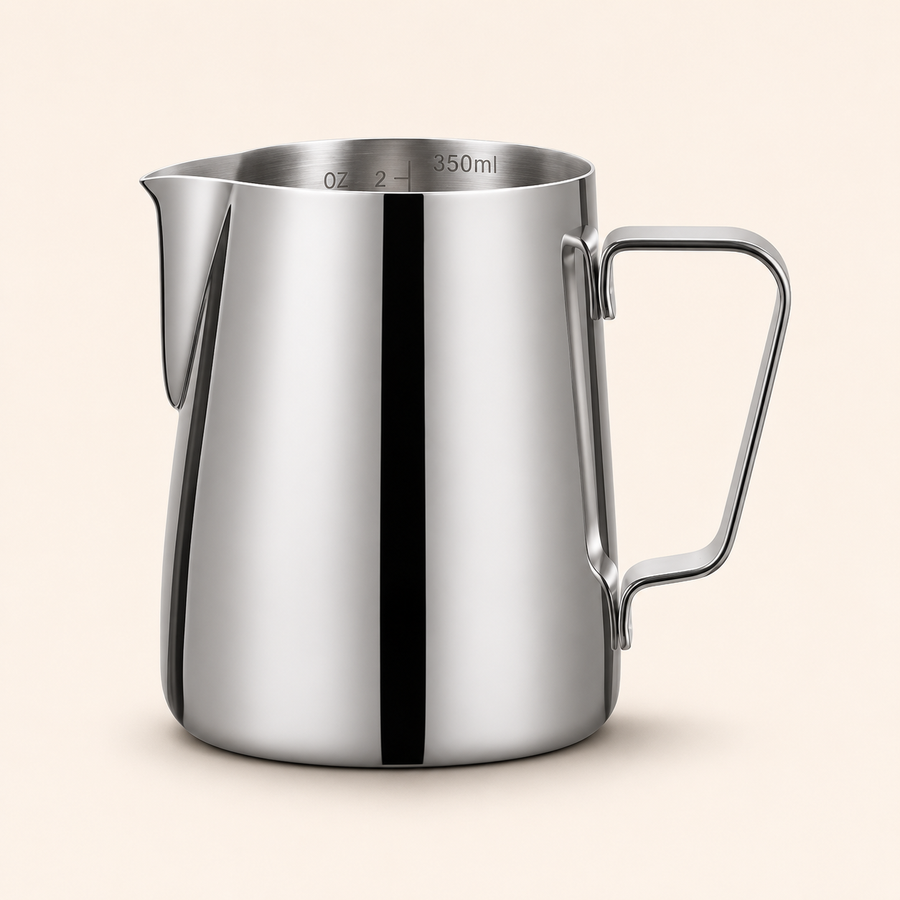
Choose a milk frothing pitcher around the drink you make and the steam wand you use. Nominal capacity describes the vessel's listed size, not how much cold milk to pour in before steaming. Milk expands as you texture it, so filling a pitcher to the rim is not a usable recipe.
A small pitcher can make sense for a single drink, but only when the starting milk amount reaches the wand appropriately and leaves enough working room. A larger pitcher is not automatically easier if your usual dose of milk barely covers its bottom.
Start with your normal drink
Measure how much milk your preferred drink actually needs. Then check your machine's instructions for minimum milk level, wand position and any required pitcher. Machines with automatic milk sensing can depend on the supplied jug or a particular setup; do not assume an aftermarket pitcher is compatible with that system.
The Compact Milk Frothing Pitcher is a 350 ml option. That listing is a capacity reference, not a recommendation to steam 350 ml at once. Check the product dimensions and compare them with the space below your wand before buying.
Three fit checks before ordering
| Check | Why it matters | How to plan |
|---|---|---|
| Wand clearance | The pitcher must be positioned and removed without an awkward tilt | Compare vessel height and your machine's working space |
| Starting milk depth | The wand needs the placement described in the machine manual | Use your normal milk amount as the reference |
| Room for expansion | Foam increases the volume during texturing | Follow the jug and machine fill guidance; do not use rim capacity as a fill target |
Handle position matters too. Picture the angle of your wrist while positioning the pitcher and while pouring into your normal cup. If possible, compare the dimensions with a vessel you already own rather than deciding from an isolated product photograph.
A spout helps, but it does not create latte art
A defined spout can make directing a pour more convenient. It does not compensate for milk texture, an unsuitable drink size or a cup that is difficult to hold. If you are learning, practice controlling the stream and serving the same drink consistently before expecting a particular pattern.
Use a cup with enough headroom for the espresso and milk. A pitcher's convenient capacity is separate from the cup's finished-drink capacity. Decide on the drink first; otherwise it is easy to steam too much milk simply because the jug has space.
Use temperature as a measured variable
Follow your machine and milk producer's instructions. As a manufacturer example, the Breville Bambino manual describes 140–149°F (60–65°C) for manual milk texturing. That is a brewing reference for its instructions, not a universal food-safety rule or a claim that every milk alternative behaves identically.
If using a dial thermometer, check the scale printed on its actual dial. A Celsius-only dial will not show Fahrenheit numbers. Position the probe as its instructions require; touching the vessel wall or base can give a misleading impression of the milk temperature. A thermometer's response is not necessarily instantaneous.
Build cleanup into the choice
Check the pitcher's care instructions rather than assuming stainless appearance means dishwasher-safe. Clean the jug after use and follow the espresso machine manual for cleaning and purging the steam wand. Hot metal, steam and hot milk require careful handling; do not use hand discomfort as a precision thermometer.
Keep the milk-cleaning cloth separate from a cloth used to sweep coffee grounds. For a manageable routine, use our coffee tool cleaning guide. If your counter is crowded, the small coffee station guide helps separate wet and dry work.
Manufacturer reference: Breville Bambino instruction manual. Theodore Coffee does not claim that its pitcher replaces a model-specific jug or sensor accessory.


