
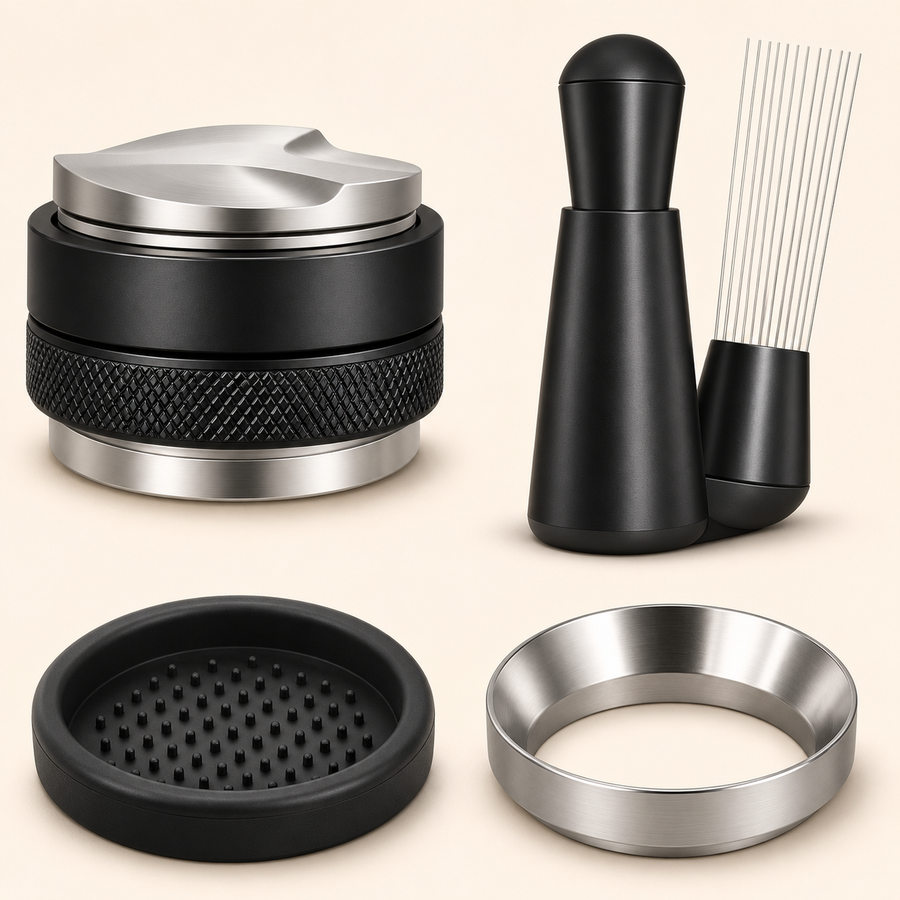
Choose an espresso tamper for the basket you actually use, not just the outside diameter of the portafilter or a size repeated in an online comment. A nominal size such as 58 mm is a starting category, not a guarantee that every item carrying that number fits every basket.
This matters when buying a preparation kit. A tamper, dosing ring, cup and organizer can each have different fit requirements. Matching the number on one piece does not confirm the whole set.
Start with documentation, then measure if needed
- Find the exact machine model and the part number or size of your basket.
- Check whether you are using the original basket or an aftermarket replacement.
- Look for the basket maker's recommended tamper diameter and any specific clearance requirements.
- If the information is unclear, measure the basket's internal opening with an appropriate tool or ask the basket maker before ordering.
Do not force a tamper into a basket to find out whether it fits. Internal taper, ridges and the depth reached by the base can all matter. A ruler across the outside of the portafilter is not the same as a reliable internal basket measurement.
What the common size labels tell you
| Label | Useful interpretation | What it does not establish |
|---|---|---|
| 51 mm | A size category to compare with a documented basket requirement | Compatibility with every small home machine |
| 53 mm | A specific tool diameter or nominal category, depending on the listing | Automatic fit for a basket described as 54 mm |
| 58 mm | A common espresso accessory category | Identical clearance across all 58 mm baskets |
Decimal-sized tampers demonstrate why nominal labels are not the full story. For example, Barista Hustle describes its own 58.4 mm tamper as fitting a VST basket. That is a claim about a particular product and basket, not evidence that a generic 58 mm tool is interchangeable with it.
Check each accessory separately
Tamper: compare the base diameter, available clearance and basket shape. A base should work without binding or leaving an obviously inappropriate gap.
Dosing ring: check the lip, retention method and whether it sits inside or outside the basket opening. Consider whether your tamper can pass through it or whether it must be removed first.
Dosing cup: check the cup's opening and transfer method, along with grinder clearance. An item labeled 58 mm is not automatically a docking cup for every grinder.
Organizer: compare the holes and slots with the actual tools and handles you own. A matching color or wood finish does not establish mechanical fit.
A useful pre-order message
If you need help choosing a variant, send the exact basket information, the measurement you took and the product variant you are considering. A message such as “Will this work with my espresso machine?” leaves too much uncertain. Mention any aftermarket basket, dosing ring or unusual portafilter design.
You can contact Theodore Coffee at admin@theodore.coffee. Do not treat a suggested size as confirmed compatibility until the relevant dimensions have been checked.
Read kit contents before choosing a size
The Espresso Preparation Kit has different style and size variants. Read the selected variant's contents instead of assuming every photograph shows what every option includes. The wood espresso organizer is a separate storage product and also needs its own fit check.
For the technique after choosing a suitable basket and tools, use the WDT preparation guide. For transferring grounds without unnecessary accessories, read dosing cups versus funnels.
Reference example: Barista Hustle Tamper product specification. Mentioning another maker's specification does not imply affiliation or compatibility with Theodore Coffee products.


