
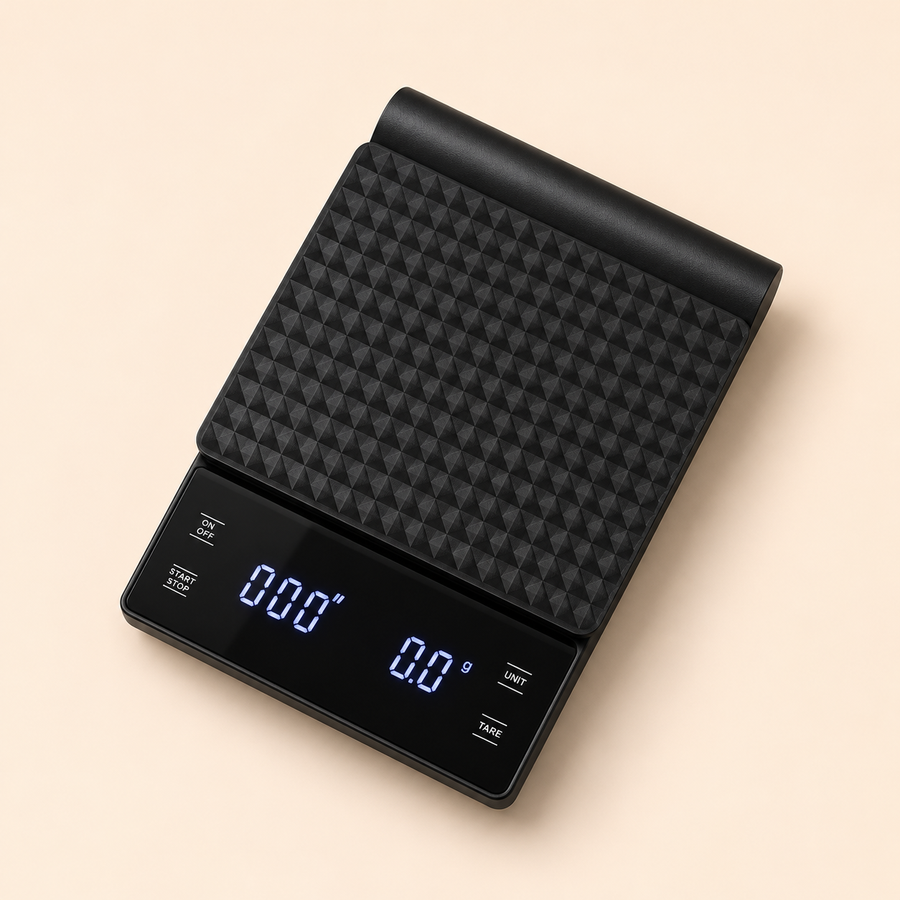
A coffee scale helps you repeat two quantities that are easy to estimate badly: your dry coffee dose and the water you add or drink you collect. The tare button subtracts a container's weight from the display. A timer gives another observation to record with the recipe.
The aim is not to chase the final decimal on every pour. It is to know what you measured, stay within the scale's limits and make the next brew comparable to the last one.
Use tare in a deliberate sequence
- Set the scale on a firm, level surface, away from anything that presses against it.
- Turn it on and let the reading settle.
- Place the empty receiving container on the platform, then tare.
- Add coffee or water and read the net amount shown.
- Before the next task, decide whether you need a new tare or want to preserve the existing total.
For a pour-over, you might weigh the dry dose in a separate cup, then put the server, brewer, filter and coffee on the scale and tare before adding brewing water. If you rinse a filter, discard the rinse water before the brewing-water measurement. Otherwise the display can represent a different quantity from the recipe.
Taring does not increase capacity
The platform still supports the container and everything in it after the display reads zero. A heavy server, dripper and water can exceed the physical capacity even if the net water reading seems modest. Add up the total load when choosing a setup.
The Rechargeable Coffee Scale with Timer is listed with up to 3 kg capacity and 0.1 g display increments. A 0.1 g increment describes how the number is displayed; it is not an independent certification that every measurement is accurate to 0.1 g.
Decide what starts and stops your timer
For pour-over, choose a consistent start such as the first water contacting the grounds. For espresso, choose a consistent machine-related reference rather than switching between pump-on and first drip without recording the difference. A time only becomes comparable when the event it measures stays the same.
Write the timing convention beside the recipe. If a new machine or technique changes the sequence, make a fresh baseline. You can learn more from a modest timer used consistently than from a precise time recorded with a changing definition.
Check unexpected readings before changing the recipe
- Confirm the display is in grams rather than ounces.
- Check whether the container touches the wall, machine or another object.
- Move the setup away from vibration and drafts.
- Check the battery and follow the manual's startup guidance.
- Ensure that the entire load rests on the weighing platform, not on the table beside it.
Water continuing to drip from a brewer or kettle can explain a changing reading; that is different from the scale drifting while an unchanged, dry object sits on it. Diagnose the situation before adjusting the grind or the dose.
Protect the scale from the brewing environment
Do not infer waterproofing, dishwasher safety, a heat rating or a particular charging specification from a product photograph. Use the supplied instructions. Keep liquid away from controls and charging connections, and do not rinse the scale under a tap unless its manufacturer explicitly allows that cleaning method.
Before using a scale in an espresso drip tray, check both fit and the permitted environment. A scale that works well on a dry countertop is not automatically suitable beneath a machine or a very hot vessel.
Make the record useful
For a filter brew, record coffee grams, water grams, grind reference, elapsed time and one taste note. For espresso, clearly label the weight of the beverage collected rather than calling it water added. Read the ratio guide to avoid mixing those definitions.
Combine the scale with a suitable serving vessel and the pour-over workflow. A repeatable measurement is most useful when the rest of the setup is stable too.


