
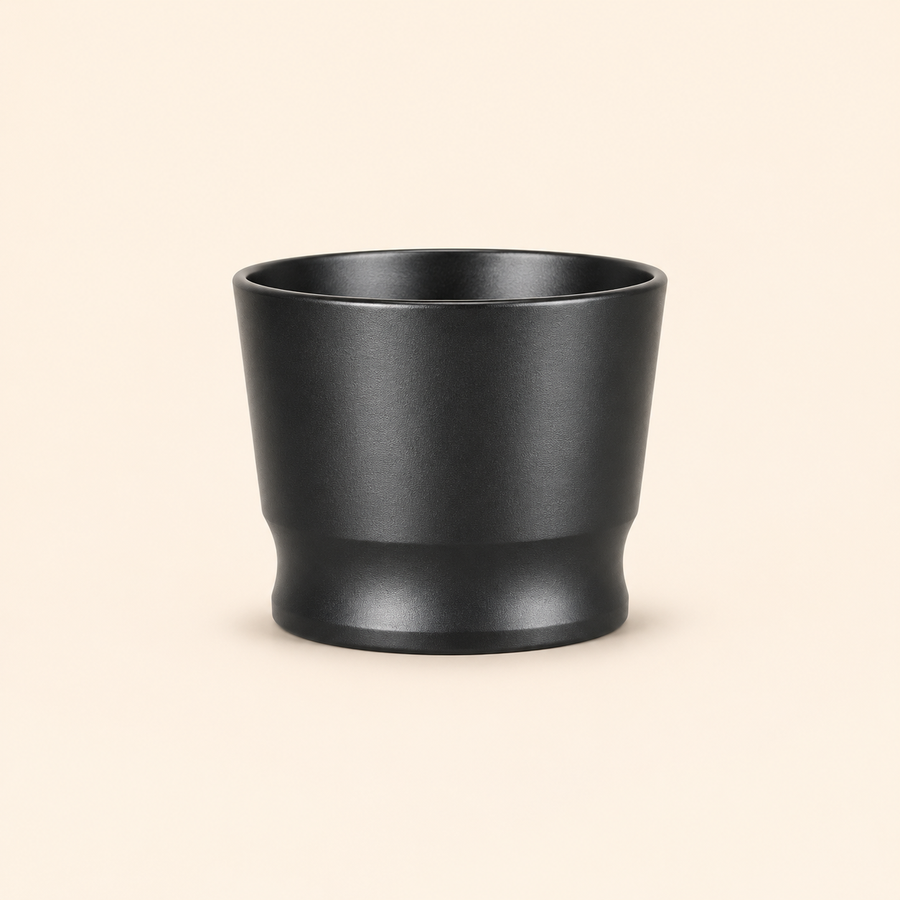
An espresso dosing cup catches or carries ground coffee before you transfer it into the basket. A dosing funnel sits on or around the basket to help contain grounds during dosing and preparation. They solve different handling problems. You may benefit from one, both or neither.
Start by noticing where the mess happens. Grounds missing the grinder's receiving vessel suggest a different problem from grounds falling over the portafilter rim while you distribute them.
A practical comparison
| Question | Dosing cup | Dosing funnel |
|---|---|---|
| Where does it work? | At the grinder and during transfer | At the basket opening |
| Main fit checks | Grinder clearance, cup opening and transfer method | Basket lip, retention and tool clearance |
| Possible extra step | Transferring grounds into the basket | Removing the funnel before tamping or brewing |
| Useful when | You want a separate vessel to catch and weigh grounds | Loose grounds spill while filling or distributing |
A funnel is not a tamper, and a cup does not make an unsuitable basket hold a larger dose. Keep the coffee amount within the range intended for your basket rather than using accessories to make an overfilled dose appear manageable.
When a cup earns its place
A cup can make sense if your grinder delivers grounds more neatly into a separate vessel than into the portafilter. It can also make checking the ground dose convenient. Tare the empty receiving cup first, then weigh the grounds in it, staying within the scale's supported load.
Before buying, measure the space beneath the grinder chute. Consider the height of the cup and how it will sit on the grinder platform. Check whether the manufacturer requires a proprietary cup, fork or magnetic mount. A product described as a dosing cup is not necessarily designed to lock into your grinder.
When a funnel is more useful
A funnel can help when grounds spill over the basket edge during dosing or WDT. The ring needs to stay stable while leaving room for your preparation tools. Some designs sit inside the basket opening; others sit around the outside. Those differences can change the space available for stirring or tamping.
Check whether the funnel must come off before tamping. After removing it, inspect the rim for stray grounds and confirm that the dose remains evenly distributed. Do not lock a funnel into the machine's group head unless that specific product and machine are designed for it.
Try one controlled workflow
- Measure the intended coffee dose using your normal method.
- Catch the grounds in a compatible cup or dose directly into the basket.
- If transferring, seat the receiving pieces securely and move the grounds carefully.
- Distribute, remove any accessory that should not remain, then tamp level.
- Check the counter and basket for spills before judging whether the accessory helped.
If your objective is less mess, evaluate mess and time rather than assuming the cup will improve extraction. If your objective is a more consistent shot, record the actual dose, beverage yield and taste too. A cleaner countertop alone does not prove that the espresso changed.
Choose only what your setup can use
The 58 mm Espresso Dosing Cup is one option to compare with your basket and grinder dimensions. Its size label is not a promise of universal docking compatibility. If considering a preparation kit with a dosing ring, inspect the selected style's included pieces and sizes first.
Use our espresso accessory fit guide for the measurements that matter. The WDT guide explains where distribution belongs after transferring the coffee.
Two useful buying questions
Should I buy both immediately?
Only if they solve two separate problems in your routine and both fit. Start with the problem you notice most often, then decide whether another transfer or containment step is worth adding.
Will a dosing cup replace a scale?
No. A cup is a container. Its size or appearance does not tell you the weight of the coffee inside it. Weigh the dose if your recipe depends on grams.


