
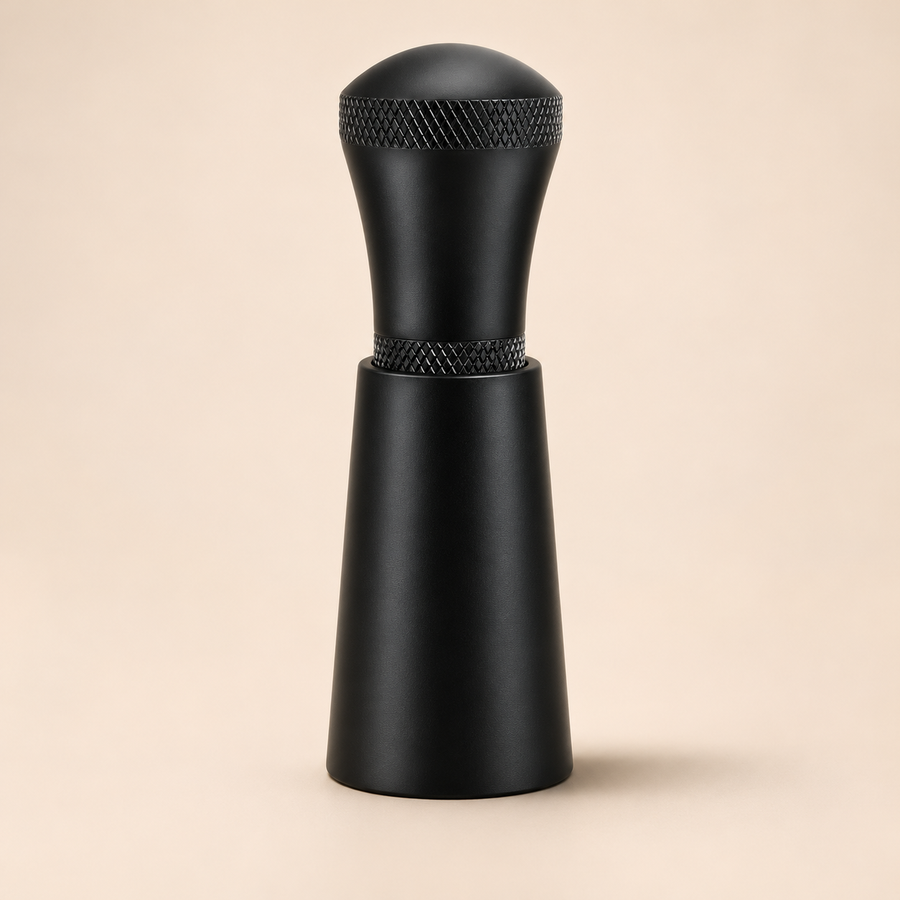
A WDT tool uses fine needles to stir loose espresso grounds in the basket before tamping. WDT stands for Weiss Distribution Technique. The aim is to break up clumps and make the bed more evenly distributed; it is not a way to compress coffee or a substitute for dialing in the grinder.
If espresso preparation already feels crowded with accessories, give each step a clear job. Dose the coffee, distribute it, tamp level and brew. Keep the sequence consistent before adding another step.
Where WDT belongs in the sequence
- Start with a clean, dry basket and the dose intended for that basket.
- Grind into the basket or transfer the dose from a suitable cup. A compatible funnel can help contain loose grounds.
- Use the needles to work gently through the bed, including areas near the edge, without levering against the basket.
- Finish with an even surface, remove the funnel if necessary and tamp level.
- Keep the basket rim clear before locking in the portafilter and brewing.
Barista Hustle's discussion of WDT distinguishes working through the coffee bed from simply smoothing its surface. It also notes that careless or aggressive stirring can make the distribution worse. That is why a calm, repeatable movement matters more than stirring for an arbitrary number of seconds.
What a useful movement feels like
Hold the tool so you can control the needle tips. Avoid scraping, stabbing or dragging the whole dose into one corner. Work across the basket rather than polishing a single central area. As you finish, reduce the depth of the movement so the surface is reasonably even and ready for tamping.
You are not trying to create a decorative pattern. A visually tidy surface can still hide uneven distribution underneath. Equally, a little surface texture is not a reason to stir indefinitely. Stop when the bed is prepared consistently enough for the next step.
Common mistakes worth removing first
- Using WDT after tamping. Stirring a compressed puck breaks the preparation you just made. If you need to start again, prepare a fresh, loose bed.
- Changing the dose at the same time. You cannot fairly compare the effect of distribution if the basket receives a different amount of coffee.
- Spilling grounds and ignoring the loss. If a meaningful amount leaves the basket, the actual brewing dose has changed.
- Judging only one shot. One attractive extraction does not establish a reliable routine. Look for a pattern over several similar shots.
Evaluate WDT with a small comparison
Use the same beans, basket, dose and target beverage yield. Record the preparation method and what the cup tastes like. If you change from your normal distribution to WDT, keep everything else as steady as practical. Compare consistency as well as taste.
A bottomless portafilter can expose visible flow behavior, but the absence of spraying is not proof of perfect extraction. Do not keep changing distribution simply because a video looks more dramatic than your own machine. Make decisions from repeated results and a recipe you understand.
WDT, a distributor and a tamper do different jobs
A needle tool works through loose grounds. A surface distributor or leveler acts differently, and a tamper compresses the bed. Buying one item called a “distribution tool” does not mean you have bought all three functions.
The WDT tool with stand is available in Matte Black and Frosted Silver. Choose the finish you prefer, check the product details and keep the needles protected when not in use. The stand is a storage aid; do not leave sharp needles exposed at the edge of a counter.
Before adding a matching kit, read how to check espresso tool sizes. If transferring coffee is the messy part of your routine, see dosing cups versus funnels before choosing another accessory.
Further reading: Barista Hustle: Weiss Distribution Technique. This is a technique guide, not a claim that every grinder or coffee will improve by the same amount.


