
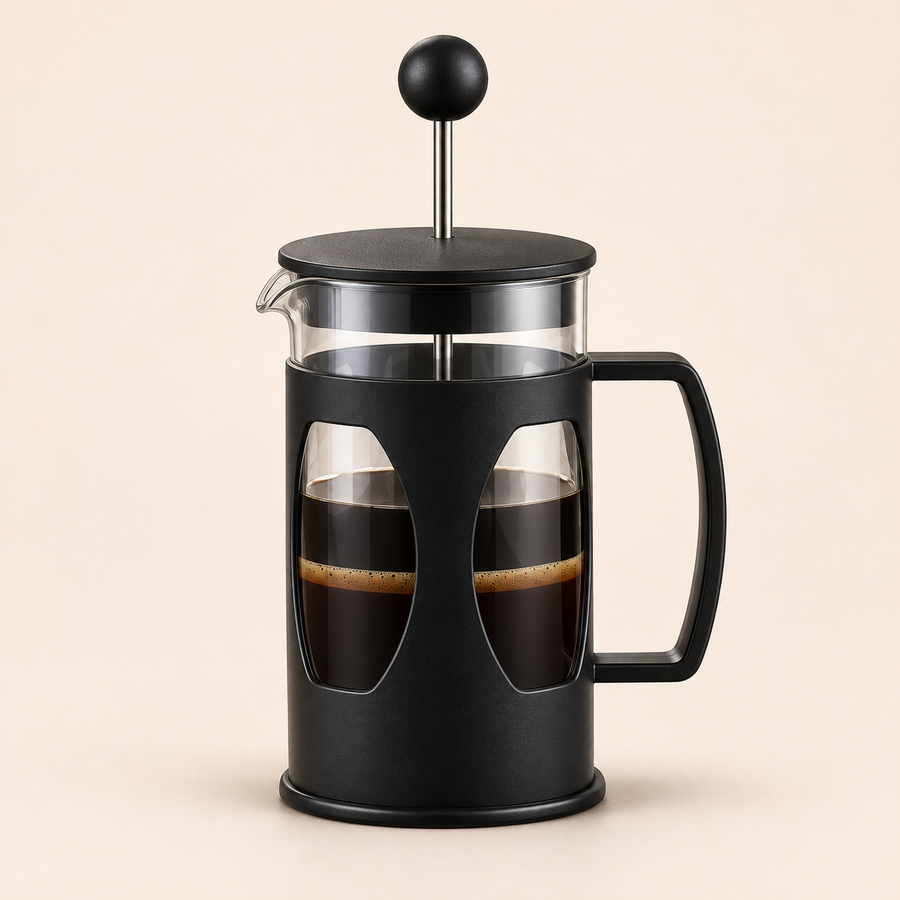
French press coffee is straightforward, but the size printed on the vessel can make a first recipe confusing. A press described as 350 ml does not necessarily accept 350 ml of water plus a full coffee dose with safe headroom. The grounds, lid and plunger need space too.
Begin with a recipe below your press's working fill limit. For example, 20 grams of coffee and 300 grams of water gives a 1:15 ratio. Only use that batch if your press's instructions and fill line allow it. For a larger suitable vessel, 30 grams and 450 grams gives the same ratio.
Plan around the water you can actually add
Check the maximum fill line and the manufacturer's instructions before brewing. Do not assume that a nominal cup count means full US coffee mugs. Different makers define a cup differently, and grounds retain some water, so beverage yield is smaller than the starting water amount.
If your mug is larger than the press's output, make a smaller drink or choose a larger brewer. Filling above the safe limit to stretch a batch can make placing the lid or plunging messy and unsafe.
| Planned water | Coffee at 1:15 | Coffee at 1:16 |
|---|---|---|
| 240 g | 16 g | 15 g |
| 300 g | 20 g | 18.75 g |
| 450 g | 30 g | 28.1 g |
A repeatable first brew
- Check that the glass, frame and filter assembly are intact and correctly fitted. Set the press on a stable surface.
- Add your measured coffee. Start with a coarse grind, then follow the brewer's specific guidance.
- Add the measured hot water within the working fill limit. Wet the grounds evenly, using only the stirring method allowed for your vessel.
- Set the lid in place and time the steep. Around four minutes is a useful initial reference, not a rule for every recipe.
- Hold the press securely and lower the plunger slowly. If resistance is unusually high, stop rather than forcing it.
- Serve carefully. If you want to keep the remaining drink separate from the grounds, decant it into a suitable serving vessel.
ESPRO's manufacturer guide uses coarse grounds, a measured recipe and slow plunging. Its filter construction differs from a conventional single-screen press, so do not assume its resistance, optional paper filters or parts fit another model.
Manage sediment without an endless equipment search
Some fine particles can remain in French press coffee. Before changing brewers, inspect whether the screen is seated, damaged or assembled incorrectly. A grind with fewer fine particles, a gentle plunge and careful serving are useful variables to evaluate.
Do not press harder to squeeze the last liquid from the grounds. Leave the final sludgy portion behind if you prefer a cleaner cup. A different filter design may suit your preferences better, but no universal technique makes every press produce the same texture as paper-filtered coffee.
Change the recipe with a purpose
If the coffee is too heavy or concentrated, compare a slightly longer ratio while holding the grind and steep consistent. If the result is weak, check the actual dose before adding time. A loosely filled scoop can make a surprisingly different recipe from a tightly packed one.
Record your water amount rather than writing only “one full press.” That makes the recipe easier to repeat when you change mugs, brew for someone else or move to a different press size. Our ratio guide explains the calculations.
Pick the press that fits your serving routine
The Theodore Coffee French press is offered in 350 ml and 600 ml variants. Choose the size by your normal batch and leave the required headroom; those nominal capacities are not promises of finished beverage volume.
A scale and timer can simplify both measuring and recording. Keep the scale dry and within its capacity. After serving, let the press cool, dispose of grounds appropriately and clean the parts according to the supplied instructions. Read the coffee tool cleaning guide for a practical cleanup routine.
Further reading: ESPRO French press brewing guide. Use your own press's manual for fill limits, assembly and care.


