
A coffee-to-water ratio tells you how much water to use for a measured amount of ground coffee. For a simple starting point with many filter brewers, try 1:16 by weight: 1 gram of coffee for every 16 grams of brewing water. That makes 20 grams of coffee and 320 grams of water an easy first recipe. Adjust it to your beans, brewer and taste.
The useful part is repeatability. Once you can make the same cup twice, you can decide what to change instead of guessing whether yesterday's scoop was fuller.
How to calculate your recipe
Multiply the coffee dose by the second number in the ratio to find the water amount. Work backward by dividing your planned water amount by that number. For example, 300 grams of water divided by 16 gives 18.75 grams of coffee. Rounding to a dose your scale can measure consistently is reasonable; a practical recipe is more helpful than false precision.
| Coffee dose | Water at 1:15 | Water at 1:16 | Water at 1:17 |
|---|---|---|---|
| 15 g | 225 g | 240 g | 255 g |
| 20 g | 300 g | 320 g | 340 g |
| 30 g | 450 g | 480 g | 510 g |
These are quantities of water added, not guaranteed quantities of coffee in your cup. Grounds retain water. Check your brewer's working fill limit before choosing a batch, especially with a small French press.
Stronger and better extracted are different
A shorter ratio such as 1:15 uses more coffee for the same amount of water and can make a more concentrated drink. A longer ratio such as 1:17 uses less coffee for that water amount. Neither change automatically fixes sourness, bitterness or an uneven brew.
If a cup tastes both thin and sharply sour, adding coffee may change its concentration without solving the brewing problem. Keep a note of the grind, pouring pattern and brew time too. A ratio is one control among several, not a flavor guarantee.
Keep different brewing methods separate
For pour-over, record dry coffee and the water you pour. For French press, record dry coffee and the water added to the vessel. Espresso recipes often describe dry coffee compared with the beverage collected in the cup. Those numbers mean different things: do not apply a filter-coffee 1:16 recipe to an espresso basket or use an espresso yield ratio to fill a French press.
Start with the recipe supplied with your brewer or coffee when one is available. Use the examples here to understand and scale it rather than replacing every manufacturer's instruction with a single number.
A three-cup adjustment exercise
- Make a baseline cup and write down the dose, water, grind setting and what you tasted.
- On the next brew, change only the ratio. Keep the other steps as close as possible.
- Compare at a similar drinking temperature. Keep the change only if you prefer the result.
If you are changing batch size, remember that a deeper bed or fuller vessel can behave differently. Matching the ratio alone does not promise matching brew time. Recheck the result before assuming the scaled recipe is finished.
Scale or scoop?
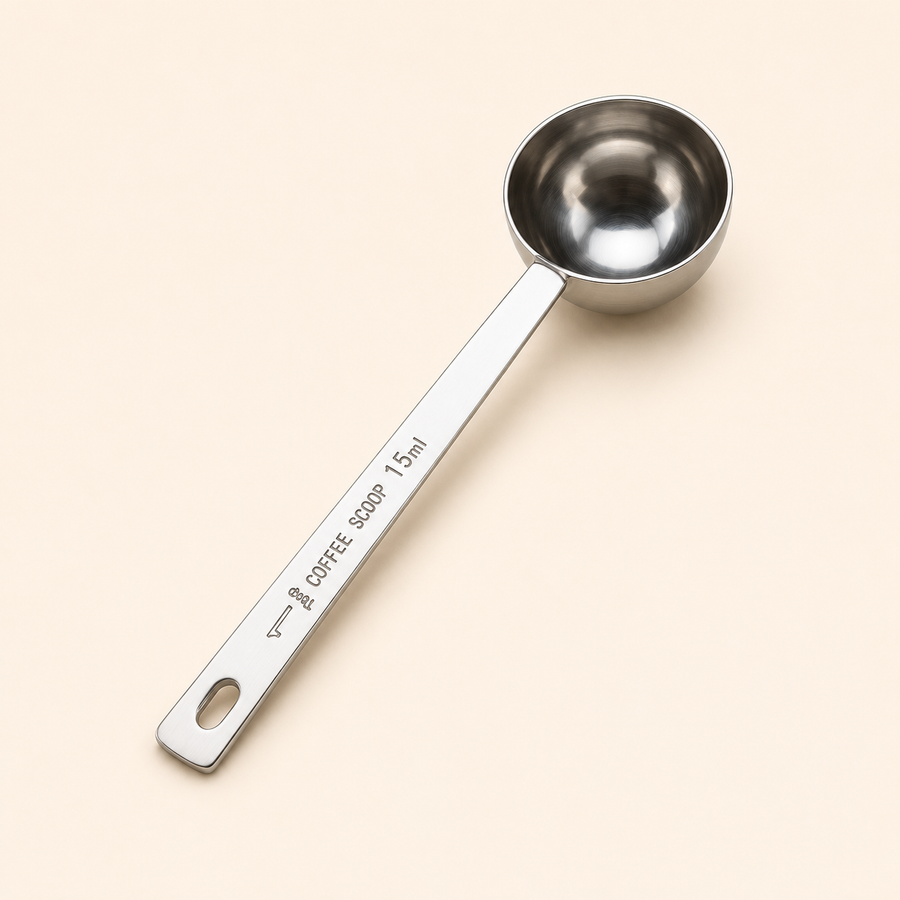
A scoop measures volume, so its coffee weight changes with beans, roast, grind and how you fill it. If you like using a scoop, weigh several level scoops of your own coffee to establish a useful household reference. Do not assume a 15 ml scoop holds 15 grams of coffee.
A measuring scoop is convenient for a quick routine. A coffee scale with a timer makes gram-based recipes easier to repeat. Read our coffee scale guide for tare, capacity and timer checks, or follow the beginner pour-over workflow to put the ratio into practice.
Quick questions
Are grams and milliliters interchangeable?
For everyday brewing, water's gram and milliliter amounts are close enough for rough planning. They are not interchangeable for dry coffee. A scale directly measures the quantity used in the recipes above.
Is 1:16 the best ratio?
It is a convenient starting point, not a universal standard or a promise. Your preferred strength and your brewer's instructions take priority.


